I’m an avid podcast listener, and one of my favourite podcasts in recent years has been the Autistic Culture Podcast, a perfect listen for commutes, with its excited and loud delivery style drowning traffic noises, and the content affirming my identity and culture while navigating public transport. Who could ask for more?
When I founded Aut2Aut, my goal was to provide free digital solutions and free content for and by the autistic community. prepped.to is such a solution, but what about the content? As you may know, Aut2Aut’s Blog has been active since the last day of 2025, and on it I’ve been sharing stories, news and opinions with you, just like I’m doing now. But being an avid podcast listener, a hyperverbal person and a bit of a performer, I wanted to also create a podcast that would be in Aut2Aut’s spirit of activism and that would be directed internally - by and for the autistic community. I wanted to, but had no idea when, or even how.
This was why I was so excited when the call came out for podcast pitch submissions for the Autistic Culture Podcast Network (aka ACPN). If I could create a podcast with an experienced professional such as Dr. Angela Kingdon, I’d do much better than fumbling through it on my own. And so ‘twas. Well, at least after we managed to pass the pitch submitting hurdle. Writing and recording my pitch was pretty easy, seeing as I was bursting with ideas. But for the life of me I could not submit the relevant form, even trying from different accounts and browsers. I ended up creating a pdf file and emailing it instead, and thankfully, Dr. Kingdon was accommodating enough to accept my rogue submission.
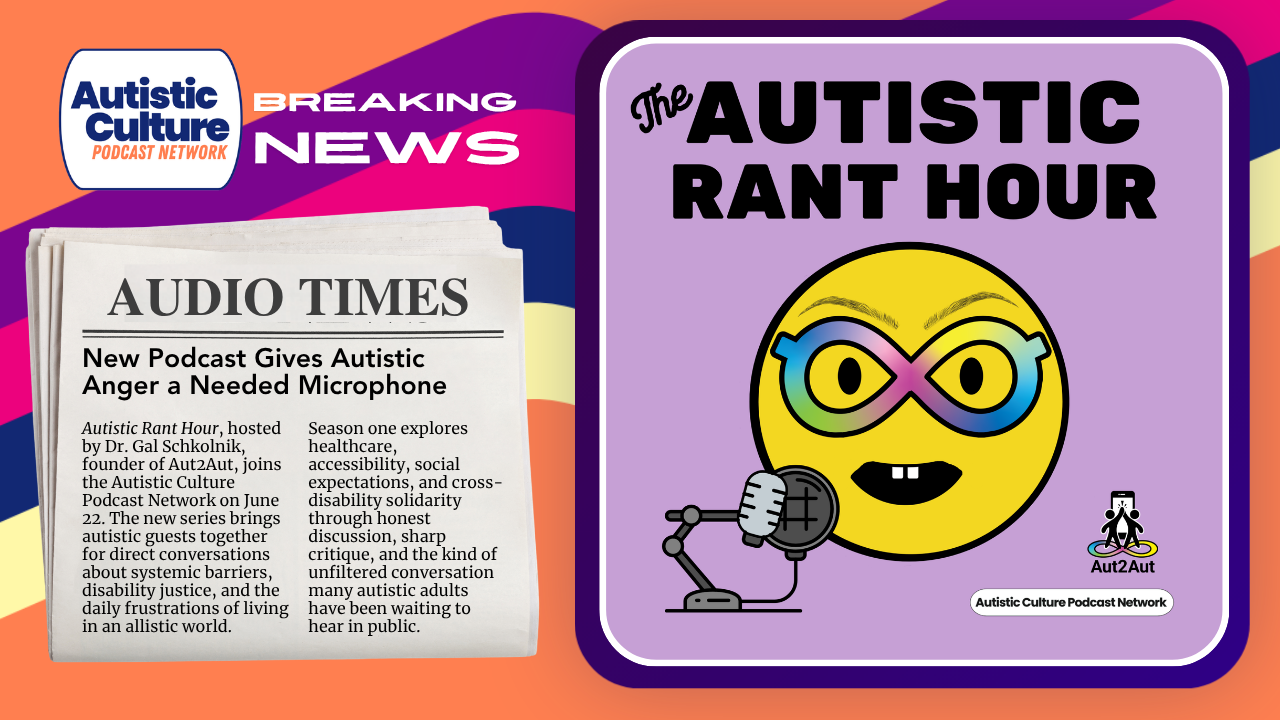
My pitch, for a podcast called The Autistic Rant Hour, where I would rant and infodump, alone and with guests, about the aggravating, the unjust, the inexplicable and the infuriating, in all fields of life, one episode at a time, was accepted for a 6 one-hour-episode pilot, and I was thrilled, but also nervous, as I had no idea what to expect or how to go about any of it.
But there are several awesome things about working with ACPN: First of all, the contract was fair, clear, readable and negotiable. We figured it out together and were on our merry way. Second, we got an onboarding document lining out what was expected of podcast creators: recording equipment and setup, submissions, brand kit, deadlines. A weekly zoom meeting and its recording were a great place to get a walkthrough of the kit, get concepts and best practices in podcasting explained for newbies like me, and have our millions of questions answered. And a Discord server has allowed creators and network folks to communicate and help each other figure stuff out and find resources and guests.
With all that at my disposal, I got to work. First thing’s first: buying a mic. I got the budget mic recommended by the network second hand, with a user’s manual and an extra pop filter to boot. I figured out how to cover all my living-room walls with fluffy blankets, by hanging them on the cat trees, to the joy of my cats, who immediately went lurking behind them, occasionally disrupting recording sessions with licking, purring and even snoring sounds.
Then I tried recording my tagline. Let me tell you: trying to record oneself saying a simple sentence for the first time is no laughing matter! I recorded for an hour and edited for three until I had a reasonable-sounding version, with no clicks, licks, inhales, or my cat Pommes pitter-pattering on the laminate flooring like a dog. He does that. When I nervously played the thing to Simon Scott, the network’s cofounder and head audio expert, he told me to try and edit less, keep it more natural and let well enough alone, it would never sound perfect. The main secret, he said, was to record it as best as possible from the get go. Recording is like cooking soup, he said, what gets in, you can never truly take out.
The next thing to do was to figure out which of the several ideas I had for episodes would actually be recorded. And that depended on what guests I could have. The episodes I thought I’d record on my own would be one about the bureaucratic nightmare of founding this here nonprofit, as well as one about the trouble I kept getting into during my years of scientific research because I refused to accept “commonly accepted values” without understanding where they came from. I definitely wanted to do one about Product Analytics, my profession for the previous decade, and I started pitching it to ex-colleagues. I wanted to do one about medical gaslighting, and I was thrilled when the founder of the queer-autistic meetup I had helped organize in Berlin agreed to be my guest on it. When I told four close friends about the coming podcast and asked them if they might consider being guests on it, two of them were interested, and that’s what determined the topics for the two remaining episodes: mental health services and accessibility across disabilities.
The last thing I needed help from my friends with was theme music. I asked Lir Lutau Shahar, a friend I’ve met via activism in the nonbinary and autistic communities, if sea would like to compose and produce it. Lir seemed like a natural choice, considering that sea was studying to create music for media. Lir interviewed me about the nature of the music I was looking for, and then provided me with 5 styles to choose from. I chose one, and sea arranged it into several different options again. Once we focused on one direction, Lir created music for the intro, outro and commercial breaks. The outcome is epic and hilarious, and I’m almost certain it will put a smile on your face.
In the meantime, I recorded and edited my exact sciences episode. The networks demanded in no unclear terms that we listen to each episode at least once before submitting it. What a great call! I listened to my episode and was horrified to get bored out of my wits about half way through. And this was about my special interest! I realized I needed a guest, not only to liven it up a bit, but also for them to ask me questions about the very field-specific topics I was infodumping about, because I had very little idea how much of it was comprehensible for someone who wasn’t from said field. I asked in the ACPN Discord if anyone would like to be my guest on this episode, and one of the other podcast creators volunteered.
I’m not sure how experienced podcasters prep their episodes, or how neurotypicals do it. Being autistic, and also having mostly autistic guests, it was important for me to discuss the episodes with the guests at least a couple of weeks in advance, so we both could script, write down and even practice what we want to talk about before the recording session. So with each guest I set up a prep meeting, at least a week after they agreed to participate. This was in itself important, so we could both think about the prep meeting and script for it too.
We then discussed our ideas of what we wanted to talk about in the episode and I took notes. I used those to outline the episode in a way that made some kind of thematic and chronological sense, with bullets for each of our parts, which I shared with my guest in a Doc, so we could each elaborate the bullets as much or as little as we wanted to before the recording.
The technical setup was different for different guests. Three episodes were done via video call, with each of us recording also locally and sharing the wav files. One episode I recorded on my own, for another my guest joined me in my cat-dominated living room using a second mic generously loaned to me by Carolina, my first episode guest. I then went to Carolina’s place with both our mics and we spent a good hour rigging their bedroom and another hour having a snack and resting, before recording our episode there. I was going to do the same with Tal(y), the guest of my last episode, but her upstairs neighbors started renovating their flat just as I was making my way to her place to record. No amount of editing would have taken the drilling noises out of that soup! Luckily, the Medienwerkstatt, a free and wheelchair-accessible recording studio in the public American Memorial Library in Berlin, was still available that afternoon, so we ended up recording there, not before fumbling with the unfamiliar hardware and software for a good hour, freaking out thoroughly, and arriving at the actual recording already at a quarter to meltdown.
But well, at least now the easy part was behind me!
Easy? You might say. That did not sound easy.
Well, let me tell you, it was a walk in the park, compared to editing the episodes to produce no more than one hour of listenable, comprehensible podcast, that would be at least passable for my public audience: autistic folks with sensitive ears, misophonia and potentially auditory processing issues. For me, a total greenhorn of audio production, it was a gargantuan task to cut the material to contain as much of the relevant content as possible, with not quite the number of many uhs, ums, “like”s, “you know”s, “I mean”s, sharp inhales and cat sounds I was amazed to find the original recordings contains (yes, there were even more of those than what you’re about to hear!). On top of that, I had to ensure that the sound was okay, even that time we hadn’t realized we shouldn’t in fact have recorded without a pop filter on the extra mic; even with guests who kept getting closer and further from the mic; even when we kept getting into each other’s words or laughing louder than our levels would allow. All that while keeping a natural flow, and not obliterating everything that makes us human and autistic, with the way we speak and breathe. Well, let’s just say that it took me 3 workdays per episode. Now, I know some autistic folks love this kind of work, but for me it was a sensory nightmare. I’m proud of the outcome, but it was so much of a nightmare, that I am only going to produce more episodes if I can find an editor. So hmu if you’re an autistic audio editor who wants to be part of this next time.
After finishing recording and editing the episodes, there were still a few things left to do. First of all, creating the repeating parts, such as the tagline, the prepped.to promos and the credits, and adding them and the theme music into the episodes.
We were also asked by the network to create promos for specific ACPN podcasts airing at the same time as ours, so that we can each promote each other’s podcasts. That was fun!
Then there was the trailer. We were asked to create short trailers for our podcasts. The trouble for me was: I can’t stand podcast trailers! They confuse and overwhelm me, and I usually just tune out immediately once I’ve realized I had accidentally downloaded or played one. But hey, that’s some good rant material, isn’t it? So I asked each of my guests to record a sentence or two about what they wanted to rant about when it came to podcasts trailers, and four of the five found the spoons to do so. I created a trailer that was less disembodied bits of the show and more a travel-size sample of it. I hope you like it, but if you can’t stand podcast trailers either, feel free to skip it, that’s perfectly fine!
So here we are. The Autistic Culture Podcast Network is going to launch on June 22, 2026, 16:00 UTC, with the first 9 podcasts to air, including The Autistic Rant Hour, and we’re having an online party! Join it here, meet the creators and people behind this initiative, and get a free copy of Dr. Angela Kingdon’s book “Am I Actually Autistic?”
Also available starting June 22, 2026 will be The Autistic Rant Hour’s first episode: Nobody Wants to Make Data-Driven Product Decisions aka Product Analytics and being Autistic in Tech, where Carolina and I will get angry and have a laugh about how weird things get when you are not only the only team that gets data, but also the only team that cares about it. I hope you like it!
The network, led by Dr. Kingdon and Simon Scott, is a truly varied collection of creators from different countries, age groups, gender identities and fields of interest, whose common denominator is autistic culture, which is as rich and multi-faceted as we are. I truly hope you like my podcast, The Autistic Rant Hour, but also that you explore the other podcasts in the network and see if you find ones that resonate with you. Please be advised that because we are such an eclectic collection of individuals, I can’t promise you that everything you’ll hear in there will be completely aligned with my and Aut2Aut’s values and worldviews, so please make sure to have a look at the show notes in advance, and keep your boundaries while listening.
The network isn’t done growing, so if what I outlined above sounds exciting and doable to you, and you’d like to create your own podcast to be aired on the network, you can pitch your idea here.
